- Part
- Part II: Minimalism and the Climate Crisis · Chapter 11
Efficiencies Offset
Minimalism goals can not be sufficiently realized through gains in efficiency. In particular technological gains in and of themselves are not working to reduce annual greenhouse gas emissions growth.
American homes today are about 31 percent more energy-efficient (as measured in energy use per square foot) than they were in 1970. But because they're so much bigger lately, with square footage rising roughly 28% (despite family size decreasing), there's pretty much been no change in overall energy intensity. The two trends balance each other out:
In Canada for example we see the trends in decreasing people per household but increasing household size. An even bigger problem we are seeing is even more appliances in the household. Do we really need these extra appliances?
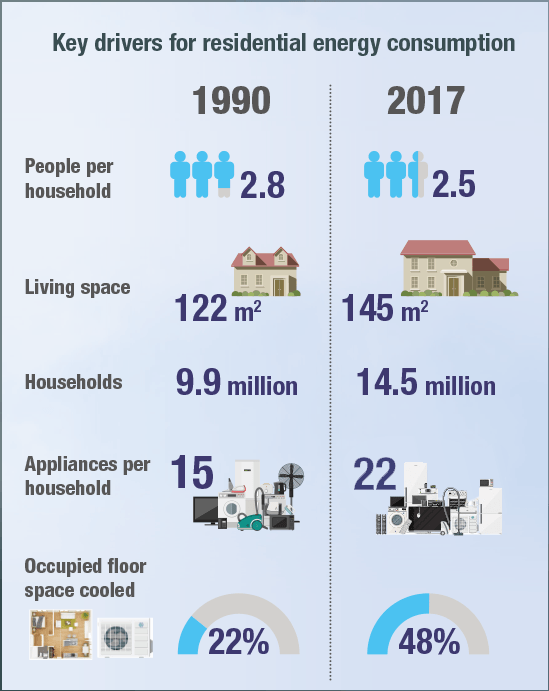
https://oee.nrcan.gc.ca/publications/statistics/trends/2017/residential.cfm
Jevons Paradox
As we perceive a consumption choice to be more cheaper and more efficient we might actually end up consuming more resources connected to it. This is called Jevons paradox or Jevons effect. Technological efficiency gains, while often seen as a solution to reducing greenhouse gas emissions, have been largely offset by the Jevons paradox. As technology improves, making energy use more efficient and lowering costs, demand for energy-intensive activities tends to rise, ultimately driving up total emissions. For example, advancements in fuel-efficient vehicles should theoretically reduce fuel consumption, but instead, they often lead to people driving more, negating the intended environmental benefits. Similarly, improvements in industrial processes and household appliances may reduce energy use per unit, but the widespread adoption and increased production of these technologies result in higher overall resource consumption. This paradox highlights the need for systemic change---simply making technology more efficient is not enough if it encourages greater consumption. Instead, policies that prioritize absolute reductions in fossil fuel use, alongside behavioral and cultural shifts toward conservation, are necessary to achieve meaningful emission reductions.
Here are some examples:
- Think about leaving the lights on. An incandescent lightbulb burns more energy and wears out more quickly than an LED/florescent alternative. However when using a newer type of lighting, people might then be less inclined to turn the light off when they leave the room. One might think, "It consumes less energy and lasts longer so who cares?" Well the energy and longevity efficiency gains are just being offset by increased use and neglect.
- When a new smartphone is released, companies talk about the increased battery longevity or increasing chip capacity. All the marketing campaigns surrounding new product releases seek to increase our awareness surrounding the efficiency gains of new items. However, as a result people typically use the phone longer or run more computationally intensive tasks. This then requires the phone be charged more often offsetting the efficiency gains of the new technology.
Comments
Loading comments…