- Part
- Part I: The Principles of Minimalism · Chapter 2
Consumption and Energy: The Hidden Cost of Our Choices
Consumption directly impacts greenhouse gas emissions through the production, transportation, and disposal of goods and services. You can think of consumption as demand and production as the supply. These forces together formulate one of the fundamental economic models in microeconomics. Individual consumer choices influence demand, which, in turn, drives production and emissions. Increased demand for goods leads to more production and resource consumption, increasing the associated emissions. Markets are directly impacted by our consumption choices. Therefore, through our consumption decisions we have control over the entire lifecycle of a product, from raw material extraction to final disposal. Ultimately, we have control over greenhouse gas emissions.
The manufacturing of goods requires energy and resources. The extraction, processing, and transportation of raw materials, such as minerals and metals, also contribute to emissions. Moving goods from manufacturers to retailers and consumers requires energy, usually in the form of fossil fuels. Modes of transportation, such as trucks, ships, airplanes, and trains, emit CO₂ and other pollutants.
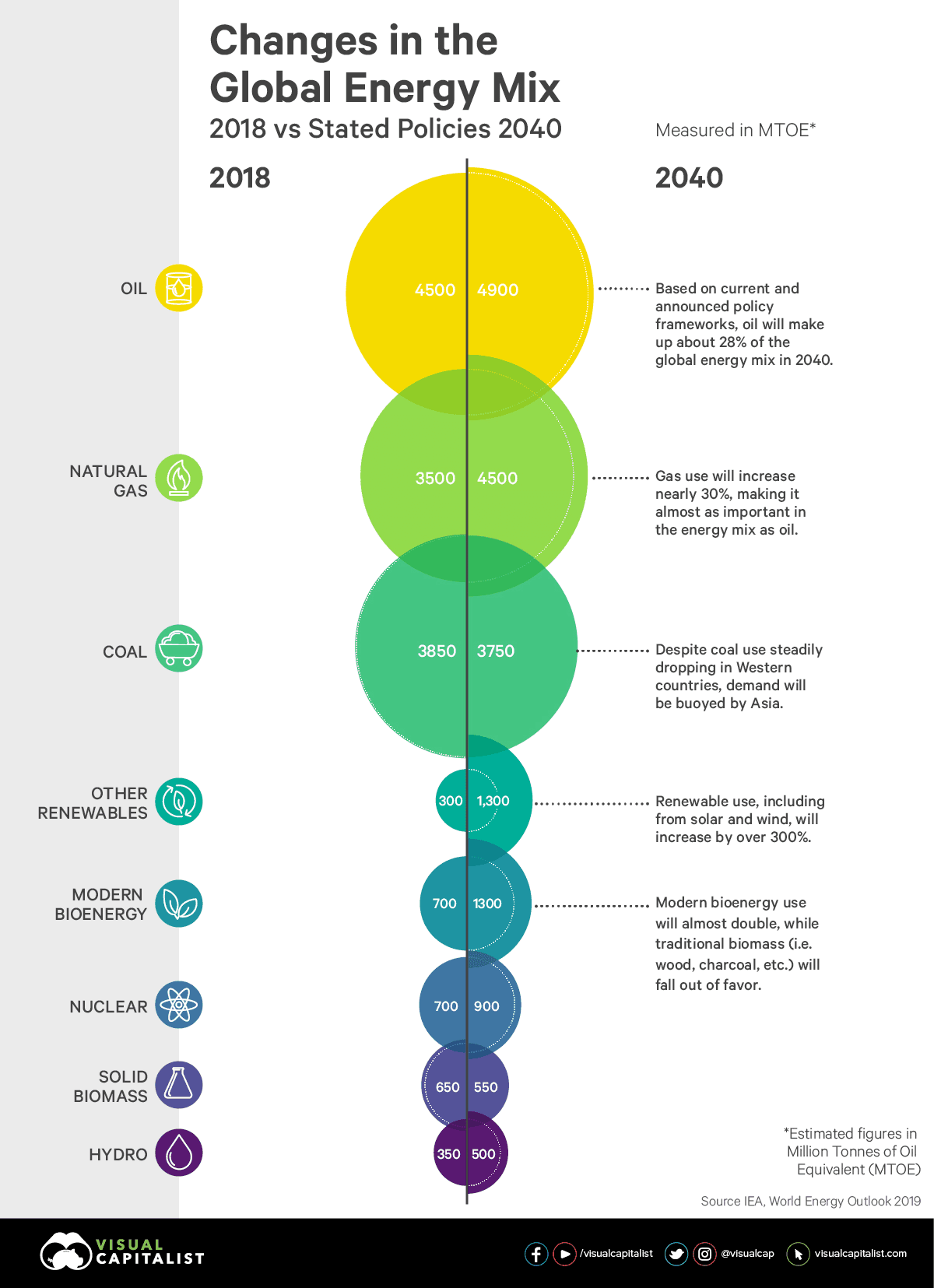
Visual Capitalist. "The World's Projected Energy Mix 2018-2040." Visual Capitalist, 13 Aug. 2018, https://www.visualcapitalist.com/the-worlds-projected-energy-mix-2018-2040/.
Consumption directly impacts how much warming we experience on this planet---because everything we buy, use, and throw away requires energy to produce. From the moment raw materials are extracted from the Earth, to when a product is refined, manufactured, packaged, transported, and finally ends up in our homes, energy is being used at every step. And that energy doesn't come from nowhere---it's generated by burning fossil fuels like coal, oil, and natural gas, or through other methods that still depend heavily on resource-intensive systems.
To make these connections more tangible, consider something as ordinary as a gallon of gasoline. When burned, that single gallon releases about 20 pounds of carbon dioxide into the atmosphere. That's because carbon from the fuel combines with oxygen in the air, producing a greenhouse gas that traps heat and accelerates climate change. Every time we drive a car, power our homes, or ship a package, we're participating in a larger, often invisible, network of emissions.
Electricity, too, carries a hidden physical footprint. Though it's easy to flip on a light switch and forget where the power comes from, much of our electricity still originates from burning fossil fuels. A coal-fired power plant, for example, needs to burn over a pound of coal to produce just a single kilowatt-hour (kWh) of electricity---the same amount of energy it takes to run a space heater for about an hour, or a refrigerator for a day. A natural gas plant, while more efficient, still consumes about 7.5 cubic feet of gas per kWh. Petroleum-derived electricity uses around 0.08 gallons of oil per kWh. Every kilowatt-hour has a physical weight---literal fuel extracted from the Earth to power our lives.
And this is where our individual choices matter. Driving across town, ordering something overnight, or cooling a large, empty room---all these actions require energy, and that energy has a cost: not just financial, but ecological. When we start to view our daily habits through this lens, we begin to see how consumption and climate change are intimately connected. The more we consume, the more energy is demanded. The more energy is demanded, the more resources are extracted and burned. And the more we burn, the more we heat the planet.
Minimalism offers an intentional response to this cycle. It's not just about decluttering your closet---it's about redefining what enough looks like, and recognizing that each purchase has an energy and emissions footprint. Every unnecessary gadget, every impulsive online order, every extra mile driven contributes to a system of resource depletion and warming. But by simplifying---by consuming only what we truly need---we reduce the burden we place on the planet's resources.
True environmentalism requires us to consume less. Carbon offsets, recycling, and green packaging may help, but they can't undo the damage caused by unchecked consumption. The most powerful environmental action we can take is to not consume in the first place unless it's essential. That's why minimalism and sustainability are so deeply intertwined. Both are rooted in mindfulness, restraint, and a long-term vision for a livable planet.
This isn't just about sacrifice. The benefits of this mindset are immediate. You spend less. You waste less. You live with more clarity and purpose. And perhaps most importantly, you begin to live in a way that aligns with the reality of our planet's limits. When we consume with intention, we preserve not just natural resources---but the possibility of a future where those resources still exist for others.
Minimalism gives us a framework to change the way we live---not just for ourselves, but for the Earth we share. Every step away from excess is a step toward balance.
Comments
Loading comments…